
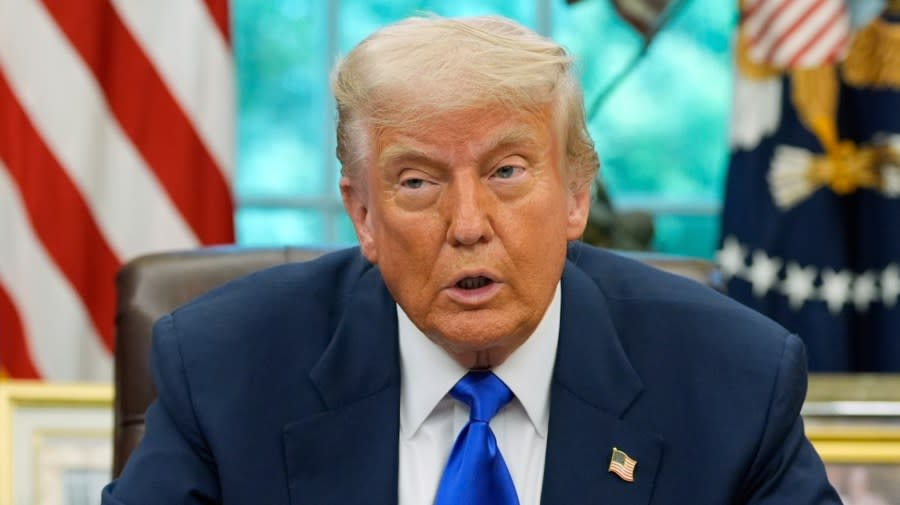
President Trump is changing his tune on the economy, suggesting Americans should buy less and will probably pay more and bear the brunt of an uncertain economic landscape as his wide-ranging tariff policy takes effect.
Trump and his economic team have for weeks said the tariffs would result in only short-term pain and that the tumult in the stock market would eventually level out.
But the White House’s messaging has evolved from Trump on the campaign trail promising to lower prices and make America “wealthy” again to Trump suggesting the U.S. needs a cultural shift on consumer spending while accepting that his tariff plan will raise prices.
Trump was asked Sunday by NBC’s Kristen Welker if he would acknowledge that his tariff plan will result in higher prices.
At first, the president suggested tariffs will “make us rich” — similar to sentiments he’s expressed when touting his economic policy. But in the next turn, he suggested that American children, for example, do not need as many toys and that Americans do not need to spend as much money on “junk we don’t need.”
“I’m just saying they don’t need to have 30 dolls. They can have three. They don’t need to have 250 pencils. They can have five,” Trump said, acknowledging the prices of such items could also go up.
That’s in stark contrast with candidate Trump, who spent much of 2024 railing against inflation under former President Biden and promising to lower costs if elected. In an ABC News interview last week, Trump said his economic policy is what voters signed up for.
Trump has in recent weeks acknowledged “a little disturbance” in the economy that emerged when his tariff plan was rolled out. When he was campaigning, Trump spoke frequently of tariffs on China, the European Union, Canada and Mexico, but his policy ultimately imposed tariffs on nearly every country in the world, sending the U.S. and foreign stock and bond markets into chaos.
Douglas Holtz-Eakin, president of the center-right American Action Forum, called Trump’s messaging “pivoting” on an unpopular policy.
“This feels tone-deaf to me. This is, ‘You’re too materialistic. You don’t need as many dollars as you think.’ And he’s a very strange messenger for that message, and I don’t think it’s going to sell,” Holtz-Eakin said.
Marc Short, who was a top aide to former Vice President Mike Pence during Trump’s first administration, warned that Trump risks alienating people if he keeps talking about dolls, calling it a “damaging message” that “suggests a little bit of an elitism perspective.”
High tariffs on China and other key trading partners will have the most impact on Americans who rely on less-expensive goods, not those who can buy 30 toys, argued Daniel Hornung, National Economic Council deputy director in the Biden administration.