
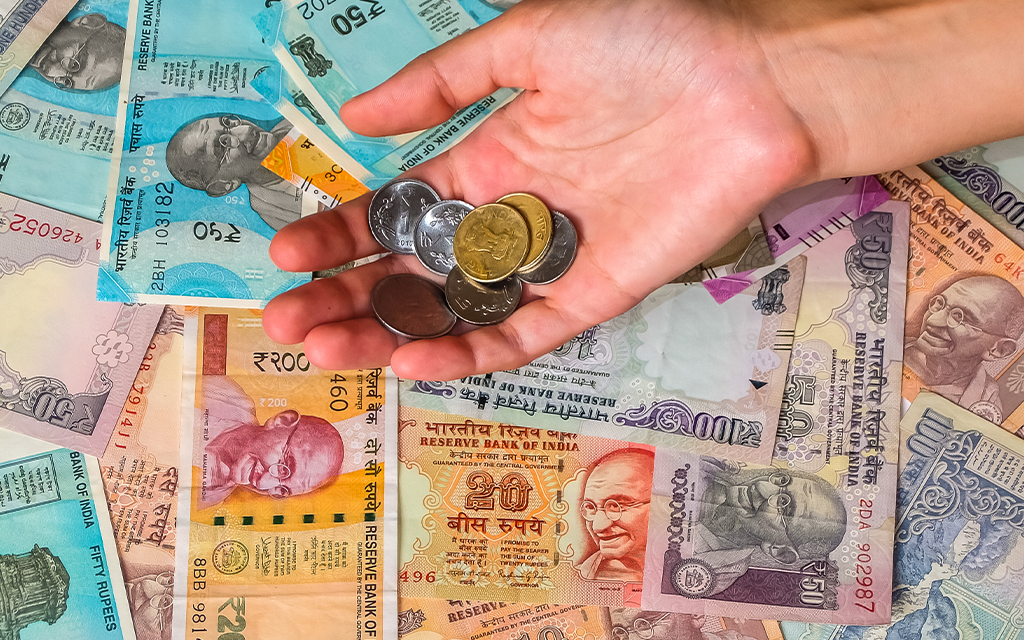
he Indian rupee opened weaker on Tuesday, mirroring a broader downturn across Asian foreign exchange markets. Renewed U.S. tariff rhetoric—this time from former President Donald Trump—has sent shockwaves through emerging market currencies, cooling investor sentiment and triggering risk-off flows across the region.
Rupee Starts the Day Under Pressure
The USD/INR pair opened the session trading near 83.91, marking a slight uptick in the dollar’s strength against the rupee. While the move remains modest in terms of percentage change, the underlying factors suggest growing unease among market participants.
The rupee’s decline was driven in large part by fears that a second Trump administration could reimpose tariffs on key Asian exporters, especially China and India. As markets began pricing in the likelihood of protectionist trade policies, demand for the Indian rupee and other regional currencies weakened noticeably.
Tariff Threats Reignite Trade Uncertainty
Former President Trump, speaking at a campaign event on Monday, indicated that if reelected, he would pursue a universal baseline tariff on all imports, with higher levies on specific sectors such as autos, steel, and semiconductors. Markets interpreted this stance as a potential re-escalation of global trade tensions, reminiscent of the 2018–2020 trade war that significantly impacted global growth and capital flows.
For India, which maintains strong trade relationships with both the U.S. and China, the prospect of increased tariffs presents a double threat:
-
Export uncertainty: Indian goods could face higher duties, undermining competitiveness.
-
Imported inflation: Higher tariffs could push up prices on imported raw materials, worsening inflationary pressure at home.
Regional Impact: Broad-Based Currency Weakness
The rupee wasn’t the only casualty. Other Asian currencies, including the Thai baht, South Korean won, and Malaysian ringgit, also came under pressure. The MSCI Asia ex-Japan Index fell nearly 0.7% intraday, driven by broad declines in emerging market equities and currencies.
Investors have turned cautious, moving capital into safe-haven assets like the U.S. dollar, Japanese yen, and U.S. Treasuries. This global flight to safety has further strengthened the dollar, exacerbating weakness in FX markets sensitive to trade flow volatility.
India’s Economic Fundamentals Still Sound
Despite the short-term market noise, India’s macroeconomic fundamentals remain relatively stable:
-
Strong FX reserves of over $645 billion
-
Robust GDP growth forecasted above 6% for FY 2025–26
-
Stable inflation close to RBI’s target range of 4%–5%
-
RBI intervention capacity to smooth volatility in the currency market
The Reserve Bank of India is expected to step in through open market operations if rupee depreciation threatens financial stability or imported inflation.
Outlook: Will Tariffs Shape Rupee’s Path?
Looking ahead, the Indian rupee is likely to stay vulnerable to:
-
U.S. political rhetoric on trade
-
Global risk sentiment and safe-haven flows
-
Crude oil price swings, which impact India’s import bill
-
RBI’s policy stance ahead of the August monetary policy meeting
If trade tensions worsen and the dollar continues to gain strength, USD/INR could test the 84.20 resistance level. However, strong RBI reserves and confidence in India’s growth story may cap further downside in the rupee.
ForexFlash Technical Snapshot
| Pair | Current Level | Support | Resistance | Bias |
|---|---|---|---|---|
| USD/INR | 83.91 | 83.50 | 84.20 | Mild Bullish |
| DXY Index | 104.6 | 104.2 | 105.1 | Bullish |