
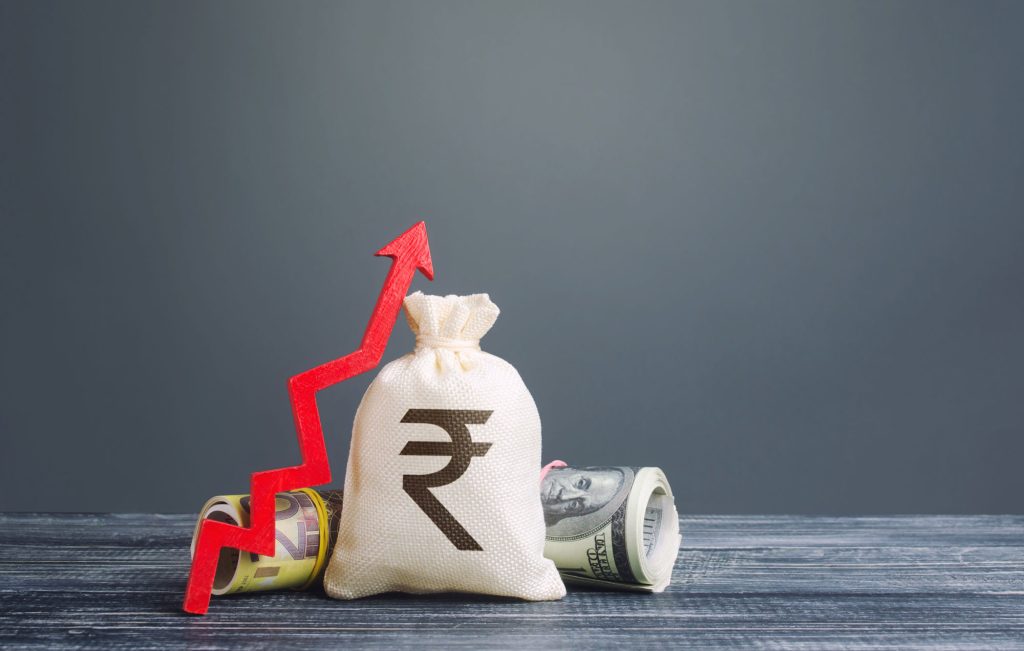
Introduction: Rupee Defies Regional Weakness, Gains Ground on USD
In a surprising show of strength, the Indian rupee (INR) appreciated by 0.18% to settle around ₹88.00 per US dollar in early Wednesday trading, despite broadly negative cues from across Asia. The rupee’s rebound comes amid a cautious global risk environment, where most Asian currencies are under pressure due to risk-off sentiment and mixed economic data.
What’s notable is the accompanying shift in the options market, where traders have scaled back bearish bets on the rupee, signaling growing confidence in short-term stability. This market action suggests that sentiment surrounding the INR may be stabilizing, at least temporarily, as positioning shifts toward a more neutral outlook.
Key Drivers Behind the Rupee’s Strength
1. Regional Risk Aversion Limited Impact on INR
While Asian currencies like the South Korean won and Thai baht lost ground due to weaker-than-expected economic indicators and global uncertainty, the Indian rupee bucked the trend.
-
Analysts point to relatively stable domestic macro fundamentals and strong foreign institutional investor (FII) flows into Indian equities as a supporting factor.
-
The rupee’s resilience is especially notable considering the tepid sentiment across Asia, driven by concerns around China’s growth slowdown and global demand headwinds.
2. Options Market: Bearish Bias Fades
Perhaps the most significant development is the change in tone within the INR options market:
-
Previously, the options market exhibited a bearish lean, where USD call options (bets on the dollar rising) were dominant, reflecting market skepticism about the rupee’s near-term strength.
-
As of today, that skew has moderated. Put-call ratios have normalized, and implied volatility has fallen slightly, suggesting traders no longer expect aggressive depreciation of the rupee in the immediate future.
“The options market shows signs of normalization, with reduced demand for upside protection in USD/INR,” said a senior derivatives analyst at a Mumbai-based investment bank.
This shift in sentiment is crucial because options pricing often leads spot movements. A more balanced options market can reduce spot volatility and support near-term consolidation in the USD/INR pair.
Broader Market Context: Oil, US Yields, and Trade Developments
1. Oil Prices Remain Stable
India, being a net oil importer, is sensitive to global crude prices. Brent crude holding below $85 per barrel has helped cap India’s import bill and alleviated pressure on the rupee.
-
A sudden spike in oil prices could change this balance, but for now, the stability in energy markets is providing a supportive backdrop.
2. US Dollar Index (DXY) Slightly Elevated
The US dollar index remains firm above 104.50, bolstered by strong labor market data in the United States and a hawkish tilt from the Federal Reserve. However, the rupee’s performance suggests a degree of decoupling, at least in the short term.
-
Traders are watching upcoming US data releases, including Nonfarm Payrolls (NFP) and ISM Services PMI, which could influence global dollar flows and the broader USD/INR trend.
3. Anticipated India–US Trade Developments
There is cautious optimism about progress in trade talks between India and the United States. Market rumors suggest a partial trade pact could be formalized by November 2025, which may further support investor confidence in Indian markets and the rupee.
Technical View: USD/INR Levels to Watch
From a technical analysis perspective, the USD/INR pair is now approaching key support levels.
-
Support: ₹87.90 – ₹88.00
-
Resistance: ₹88.40 – ₹88.60
A sustained break below ₹88.00 could invite further rupee strength toward ₹87.70. On the upside, failure to hold below ₹88.00 may see a reversion toward ₹88.50 in the short term.
Technical indicators such as the Relative Strength Index (RSI) and MACD are showing early signs of a bearish-to-neutral reversal, aligning with the shift in options sentiment.
What This Means for Traders and Investors
For currency traders, this is a signal to stay agile. With the options market turning more balanced, spot moves may be less volatile, providing more predictable trading setups.
For corporates and hedgers, this could be a short-term window to manage forex exposures more effectively, especially if further rupee appreciation materializes.
For investors, the reduced volatility and improved sentiment may translate into more consistent foreign flows into Indian equities, particularly in defensive sectors and export-oriented industries.
Conclusion: Rupee Finds Its Footing – But Can It Hold?
The Indian rupee’s rebound today is more than a technical bounce—it reflects a broader recalibration in sentiment, driven by market positioning and a shift in short-term expectations. The options market softening its bearish stance is a significant clue that traders are starting to see value in the rupee, or at least less downside risk.
However, the coming days will be crucial. The rupee’s ability to sustain gains amid global headwinds, potential US dollar strength, and external shocks like oil price volatility will determine if today’s move is the start of a new trend—or just a temporary reprieve.