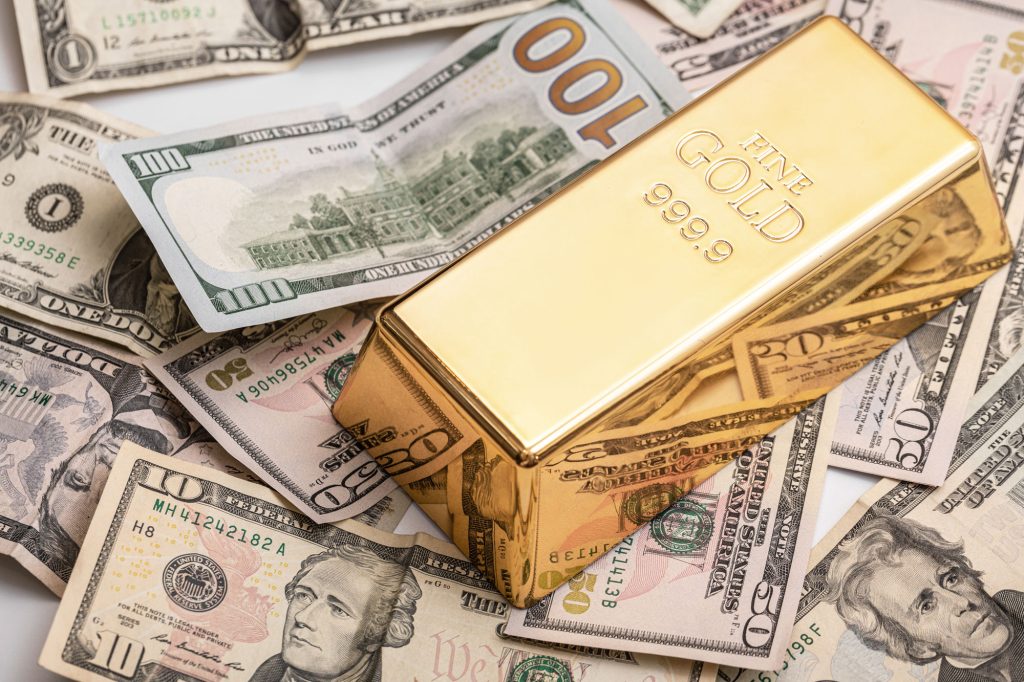
Gold prices remained steady on August 21, 2025, with spot gold hovering at $3,341.93 per ounce. Traders across global markets are positioning cautiously ahead of the highly anticipated Jackson Hole Symposium, where Federal Reserve Chair Jerome Powell is expected to provide fresh guidance on U.S. monetary policy.
The session reflected indecision: a slightly stronger dollar and steady U.S. Treasury yields weighed on gold’s appeal, while safe-haven demand offered enough support to prevent major losses.
Dollar and Yields Pressure Gold
The U.S. dollar index edged higher, strengthening against major currencies. This move increased the cost of gold for non-dollar buyers, limiting demand from overseas markets. At the same time, Treasury yields stayed firm, making interest-bearing assets more attractive compared to gold, which offers no yield.
Analysts stressed that the interplay between the dollar and yields remains the dominant driver for gold in the near term. Until Powell’s speech provides direction, gold is unlikely to break decisively in either direction.
Technical Outlook: Key Levels in Play
From a technical perspective, gold has been consolidating between $3,300 and $3,400 for several sessions.
-
Resistance: $3,400 remains the critical ceiling. A break above could open the way toward $3,450.
-
Support: $3,300 acts as a strong floor, with additional demand expected if prices approach this level.
Traders noted that this narrow range reflects market hesitation. Many investors prefer to remain on the sidelines until the Fed’s policy stance becomes clearer.
Broader Precious Metals Market Softens
Other precious metals moved lower during the session:
-
Silver slipped to just under $30 per ounce, dragged down by weak industrial demand.
-
Platinum edged lower, pressured by sluggish automotive and industrial activity.
-
Palladium also retreated, extending its downtrend amid reduced demand in the auto sector.
Gold’s relative stability compared to its peers highlights its unique role as a store of value in uncertain conditions.
Why Jackson Hole Matters
The Jackson Hole Symposium is one of the most closely watched events in global finance. Central bankers, economists, and policymakers use the forum to discuss long-term economic challenges, but the Fed Chair’s remarks often carry immediate market impact.
If Powell adopts a dovish tone and hints at easing policy later this year, the U.S. dollar could weaken, providing tailwinds for gold. Conversely, a hawkish signal reaffirming commitment to fight inflation could push yields higher, pressuring gold below $3,300.
Markets are currently pricing in two rate cuts by mid-2026, but any shift in Powell’s rhetoric could adjust those expectations rapidly.
Macro Drivers Supporting Gold
Beyond U.S. monetary policy, several macro factors support the gold market:
-
Geopolitical risks: Ongoing conflict in Ukraine and rising tensions in Asia continue to sustain safe-haven flows.
-
Economic slowdown fears: Weak growth indicators in Europe and China have raised concerns about global stability, making gold attractive as a hedge.
-
Central bank buying: Emerging market central banks remain active gold buyers, diversifying reserves away from the U.S. dollar.
These underlying drivers provide a solid floor for gold prices, even when short-term pressures from the dollar and yields intensify.
Investor Positioning and Sentiment
Institutional investors maintain steady exposure to gold, viewing it as a strategic hedge against inflation, currency volatility, and systemic risks. Exchange-traded funds (ETFs) have seen modest inflows this week, while physical demand in Asia—particularly in India and China—remains firm ahead of seasonal festivals.
Retail traders, however, are adopting a more cautious approach, preferring to wait until Powell’s comments provide a clearer signal.
Outlook: A Market in Wait-and-See Mode
For now, gold remains in consolidation mode, awaiting direction from the Fed. Short-term volatility is likely once Powell delivers his remarks, with prices poised to test either end of the current range. In the medium term, structural drivers such as central bank buying, geopolitical uncertainty, and potential global slowdown provide ongoing support.
Unless the Fed signals a much more aggressive tightening path, analysts expect gold to remain resilient above $3,300 and potentially retest $3,400 in the coming weeks.