
Introduction
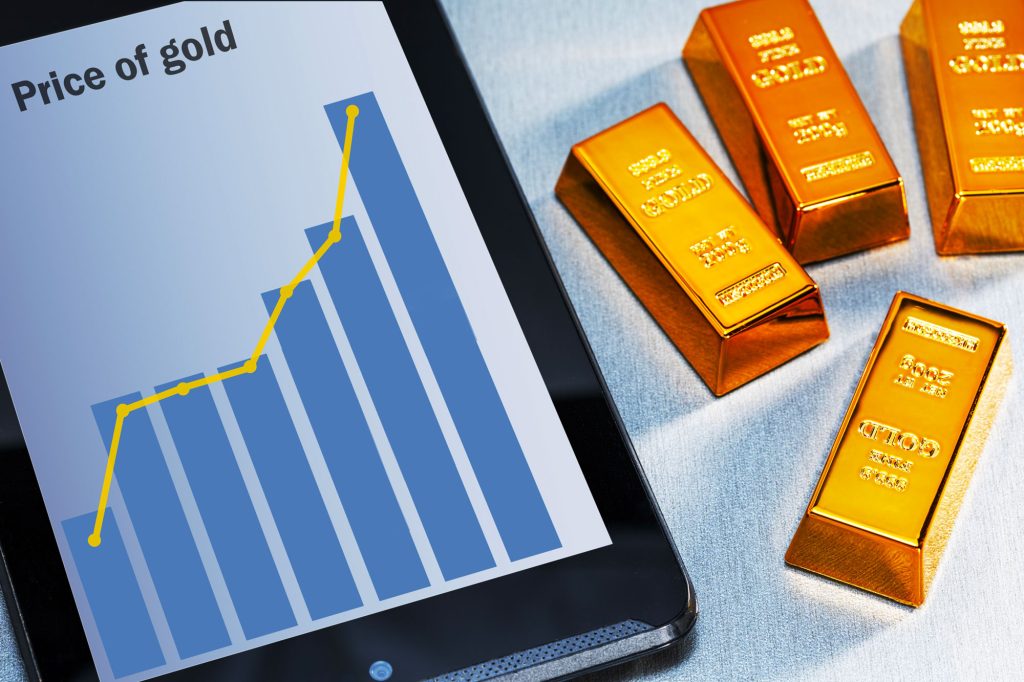
Gold prices opened modestly higher today, with futures contracts trading just below the critical $3,400 per ounce mark. The yellow metal continues to maintain a firm technical footing amid record-high equity valuations, investor caution, and upcoming monetary policy decisions that could shape the next phase of cross-asset performance.
As traders prepare for a pivotal week featuring central bank announcements, global macro updates, and geopolitical risk developments, gold is consolidating near historic highs—reflecting its status as a strategic hedge in a volatile financial landscape.
Gold Holds Firm Near $3,400
Gold futures opened the session at $3,398.60, inching up 0.1% compared to Thursday’s close. While the metal has not yet retaken the $3,400 psychological level, it remains elevated on the back of macroeconomic uncertainty and shifts in institutional positioning.
Technically, gold continues to respect a rising trendline that began in early Q2, with strong support around $3,350 and resistance near $3,420. Analysts note that this tight consolidation range indicates investor hesitation as they await clarity from central banks and fiscal leaders.
Factors Supporting Gold Stability
Several key drivers are contributing to gold’s current strength:
-
Inflation Uncertainty – Although inflation has cooled from its 2024 peaks, core prices remain sticky. Investors see gold as a hedge against potential upside surprises in inflation, especially if energy prices rise again in H2 2025.
-
High Equity Valuations – The S&P 500 and Nasdaq are trading near all-time highs, leading many institutional investors to rebalance portfolios and increase exposure to non-correlated assets like gold.
-
Central Bank Policy Outlook – With the Federal Reserve, European Central Bank (ECB), and Bank of Japan (BoJ) all set to meet in the coming days, the risk of policy missteps is elevated. Traders are seeking protection against the possibility of hawkish rhetoric or unexpected tightening.
-
Geopolitical Risks – From U.S.–China trade negotiations to instability in parts of the Middle East, geopolitical concerns are keeping a floor under gold demand. While not in crisis mode, global tensions continue to simmer.
-
Central Bank Buying – Sovereign institutions—particularly in emerging markets—have remained consistent gold buyers in 2025, bolstering demand even during periods of price consolidation.
Investor Behavior and Positioning
Data from derivatives markets show that net long positions in gold futures have increased over the past two weeks, while open interest is climbing—suggesting growing participation from both institutional and speculative traders.
ETF flows have also stabilized after months of outflows earlier this year. The rebound in gold-backed exchange-traded funds signals renewed confidence in gold as a strategic asset amid portfolio diversification needs.
Notably, physical gold demand in Asia has been resilient, with strong seasonal purchases in India and increased central bank accumulation across Southeast Asia.
Broader Commodities Context
The gold market is moving in tandem with broader commodity flows. Oil prices are stable, with Brent crude trading near $69 and WTI around $66. Industrial metals like copper and silver are also seeing steady interest, but gold continues to outperform peers in terms of volatility-adjusted returns.
The U.S. dollar remains firm, limiting the upside in gold pricing for non-dollar investors, but the metal’s strength in dollar terms indicates healthy global demand.
Technical Analysis
From a charting perspective:
-
Support zones: $3,350, then $3,290
-
Resistance zones: $3,400 (psychological), $3,420 (technical)
-
Momentum: Neutral-to-bullish; RSI near 58 on daily charts
-
Pattern: Tight ascending wedge, often a bullish continuation pattern
If gold can break above the $3,400 level on volume, it may target new record highs in the $3,450–$3,480 range. A failure to hold above $3,370 could trigger a pullback to prior support.
Outlook for the Coming Week
With the Fed, ECB, and BoJ poised to make decisions, gold is likely to remain rangebound until policy clarity emerges. However, any signal of slower economic growth, persistent inflation, or rising political tensions could act as a catalyst for gold to break out.
If equity markets retreat or the U.S. dollar softens after central bank comments, gold could be one of the prime beneficiaries. Conversely, a surprise in hawkish rhetoric or stronger-than-expected economic indicators may trigger a short-term correction.
Conclusion
Gold remains in a strong position as it hovers just below the $3,400 mark, supported by macroeconomic caution and technical resilience. As central banks dominate headlines next week, the metal’s next move will likely be driven by shifting interest rate expectations and investor sentiment around global stability. In a world of uncertainty, gold continues to shine as a cornerstone asset for diversified portfolios.